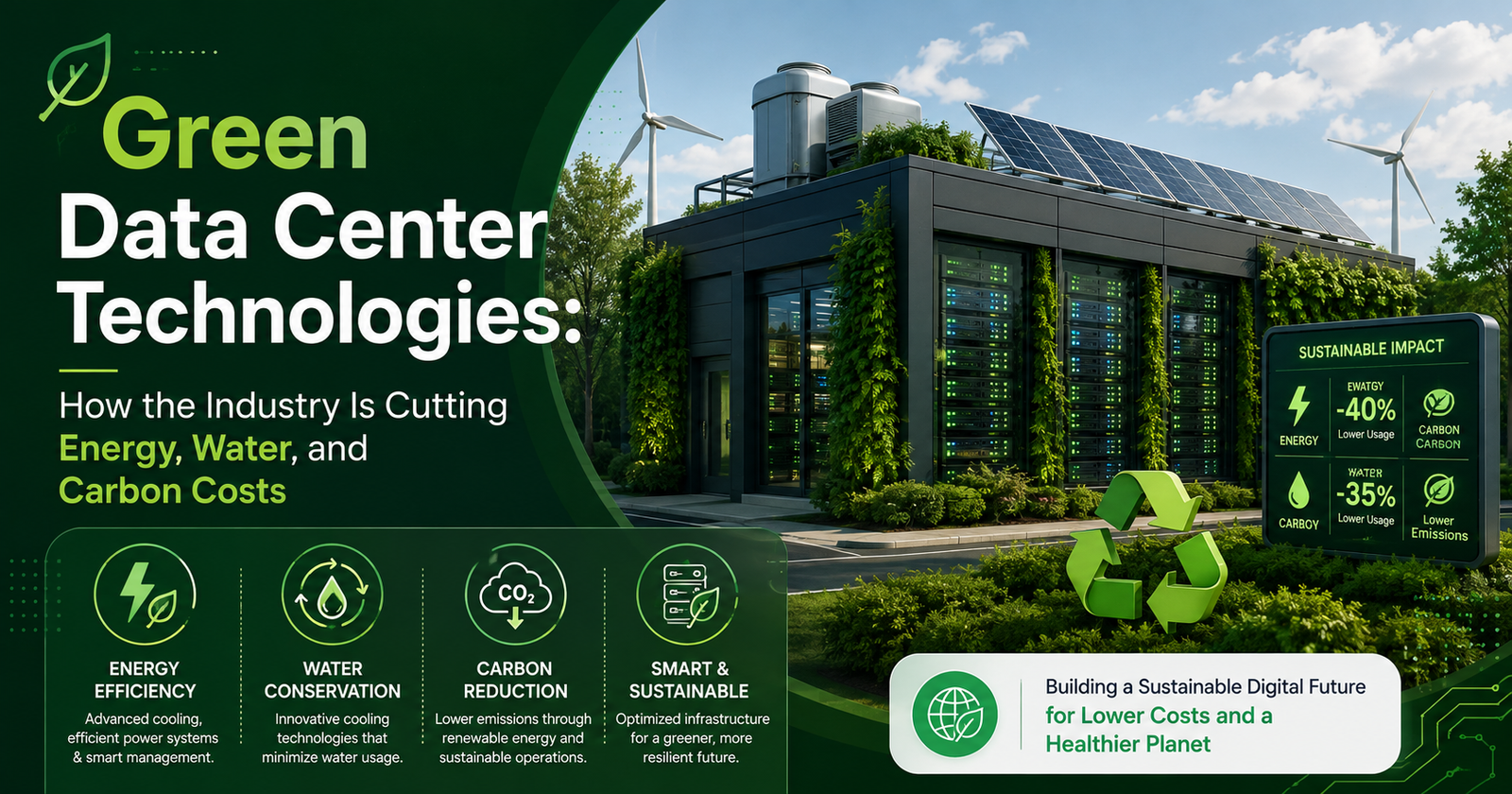
Green Data Center Technologies: How the Industry Is Cutting Energy, Water, and Carbon Costs

Nobody thinks about data centers until something breaks. That’s kind of the whole point of them, honestly, quietly running most of modern life in the background — every video call, every cloud file you save, every AI query, every online order. All of it passes through a building somewhere packed with servers running nonstop, and that constant operation has a massive energy footprint that most people never see or think about. As demand keeps climbing, and AI workloads especially are pushing power consumption way up, the pressure on operators to clean up their act has gotten intense. Green data center technologies are the industry’s response, and honestly, they’re moving faster than most people outside the field realize.
I want to get into what this actually involves, why it’s stopped being optional, and the specific technologies driving all of it.
Why This Became a Problem in the First Place
A data center isn’t just racks of servers sitting there. It’s servers plus networking gear plus storage plus backup power, and — often eating as much energy as the computing itself — the cooling systems needed to stop all that hardware from cooking itself.
As cloud computing scaled over the last decade, and now with AI adding this huge extra spike on top, energy consumption has become genuinely impossible to ignore. Training and running large models takes an enormous amount of computing power. That power has to come from somewhere, obviously. Which is how sustainability went from a corporate talking point buried in an annual report to an actual operational concern — energy costs hit the bottom line directly, and the regulatory and public pressure isn’t slowing down.
What “Green Data Center” Actually Covers
There’s no single certification that defines this, no universal checklist. Generally, it means facilities built to cut energy use, cut water use, lower emissions, and reuse waste wherever it’s practical — all while still hitting the same performance and reliability standards a normal facility has to meet. Usually breaks down into four areas: cooling, where the electricity actually comes from, how efficiently the hardware gets used, and what happens to waste heat and materials afterward.
The industry benchmark everyone uses is Power Usage Effectiveness, PUE. Simple ratio — total facility energy divided by the energy actually going to computing equipment. A PUE of 1.0 would mean, theoretically, every watt entering the building powers computing directly, zero overhead. Older facilities often sat above 2.0 — meaning more energy went to cooling and overhead than actual computing, which sounds bad because it is. The most advanced green facilities today are pushing that number down toward 1.1, sometimes lower.
Cooling, the Biggest Piece of This
Cooling has historically been the single biggest energy drain outside the computing hardware itself, which is exactly why it’s where green tech has made the most visible difference.
Liquid cooling is probably the biggest shift here. Instead of relying purely on chilled air blowing across racks, liquid cooling circulates coolant right to or near the chips generating heat, pulling that heat away far more efficiently than air ever could manage. Especially relevant now because high-performance AI chips throw off way more heat per square inch than older server hardware, which makes plain air cooling kind of impractical once you’re operating at real scale. Two common flavors — direct-to-chip cooling, where coolant plates sit right on top of the processors, and immersion cooling, where entire servers just get submerged in a non-conductive fluid.
Free cooling is another one, and it’s refreshingly simple as an idea. Skip the energy-hungry mechanical chillers whenever you can, and just draw in outside air — or use outside air to cool water in the system — whenever the weather cooperates. Facilities in cooler climates, northern regions, and coastal areas can lean on free cooling for a big chunk of the year, cutting a huge amount of energy that would’ve otherwise gone to mechanical refrigeration running constantly.
Hot and cold aisle containment is standard practice now in efficient facilities. Physically separate the hot air servers throw off from the cold air being pumped in, and you avoid the wasteful mixing that forces cooling systems to work way harder than they need to.
Where the Power Actually Comes From
Cooling only solves part of it. The other big lever is the source of the electricity itself. Large operators have become some of the biggest corporate buyers of renewable energy on the planet, signing long-term deals directly with wind and solar farms to lock in clean power at scale.
Some go further, building their own solar arrays right on-site, on rooftops or adjacent land, to supplement what’s coming off the grid. Battery storage is increasingly paired with this too, smoothing out the natural ups and downs of wind and solar so a facility isn’t forced to fall back on fossil-fuel grid power every time generation dips.
There’s a newer, more debated trend too — small modular nuclear reactors and similar advanced nuclear tech, being explored as a stable, carbon-free source for facilities with really high, constant demand. Still early days for this one though, not exactly mainstream yet.
Reusing the Heat Instead of Just Venting It
One of the more overlooked technologies here — capturing the huge amount of heat data centers naturally throw off and actually using it, instead of just venting it straight into the atmosphere like most older facilities do. Some, particularly in colder climates, pipe that waste heat into district heating systems, warming nearby homes or offices or even greenhouses. What used to be a pure energy loss turns into an actual community resource. Getting more common across parts of Northern Europe, especially, where district heating infrastructure already exists and this slots right in.
The Hardware Itself Matters Too
Green data center tech isn’t only about the building and its systems. Hardware plays a big role too. Modern processors and specialized AI chips increasingly get designed around performance-per-watt as a core goal, so newer generations often do meaningfully more computing using the same or less energy than what came before.
Virtualization and workload consolidation cut down how many physical servers you need for a given amount of work, which reduces both energy use and physical footprint. Intelligent workload scheduling pushes this further — shifting non-urgent tasks to whenever renewable availability is highest or grid demand lowest, basically syncing computing activity with the cleanest power available at any given moment.
Hardware lifecycle management, responsible recycling and refurbishing of old equipment, has become a bigger piece of the sustainability picture too, since manufacturing brand new hardware carries its own hefty carbon cost that’s easy to forget about.
Water, Which People Forget About
Cooling systems in a lot of traditional data centers use enormous amounts of water, evaporative cooling especially, and that’s become a serious issue in drought-prone regions specifically. Green design increasingly favors closed-loop systems that recirculate the same water over and over rather than constantly drawing fresh supply, cutting overall consumption dramatically. Some facilities have moved to air-based or liquid-based cooling specifically to avoid water-intensive evaporative methods altogether, particularly anywhere local water scarcity makes the traditional approach politically or environmentally impossible to justify anymore.
Actually Measuring Progress
As sustainability becomes a bigger piece of corporate reporting and customer expectations, transparent measurement matters more than it used to. Beyond PUE, operators now track things like Water Usage Effectiveness, Carbon Usage Effectiveness, renewable energy percentage — publishing this stuff publicly as part of broader sustainability commitments. Matters a lot for enterprise customers who have their own emissions targets and need real visibility into the footprint of whatever cloud infrastructure they’re relying on.
The Part Nobody Solved Yet
None of this erases the basic tension underneath it all — computing demand, AI especially, keeps growing faster than efficiency gains alone can offset. Even the most efficient facility still uses significant energy, and building new capacity fast enough to meet demand while staying committed to renewable sourcing puts real strain on regional power grids in some places. There are legitimate open questions too — how fast small modular nuclear can realistically scale, whether enough renewable capacity even exists in certain regions yet, how quickly liquid cooling can get retrofitted into older buildings that were never designed for it in the first place.
Final Thoughts
Green data center tech moved well past symbolic stuff a while ago — planting trees, buying offsets, that kind of thing. This is genuine engineering now: advanced cooling, direct renewable sourcing, waste heat reuse, hardware built from the ground up with efficiency baked in. As AI and cloud demand keeps climbing, the pressure on operators to keep pushing this forward isn’t going anywhere. If anything, the facilities adopting this stuff early are setting themselves up for lower operating costs and more resilience long-term, regardless of how the broader sustainability conversation shifts from here.



[…] counted my open tabs the other day out of curiosity. Thirty-one. Half of them I couldn’t even remember opening, and two were duplicates of the […]
[…] high school biology teacher told our whole class, dead-confident, that we only use 10% of our brains. I repeated that fact to basically everyone I knew for years afterward. It’s not […]
[…] simple trivia, understanding the messier real history behind familiar tech reveals something genuinely useful about how innovation actually works. Good ideas sit around […]