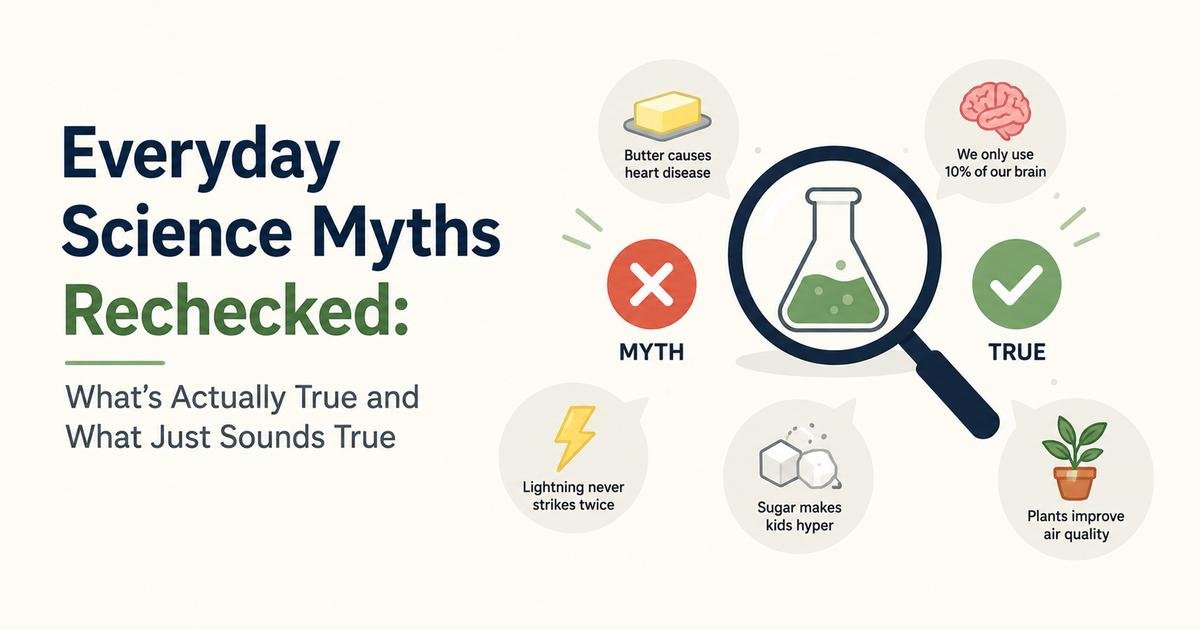

My high school biology teacher told our whole class, dead-confident, that we only use 10% of our brains. I repeated that fact to basically everyone I knew for years afterward. It’s not true. Not even close. Finding that out years later, almost by accident while reading something totally unrelated, made me start questioning a bunch of other “facts” I’d been casually repeating without ever once checking them.
Here’s a rundown of common science myths. The kind that get repeated constantly, sound completely plausible, and just don’t hold up once you actually dig into the evidence.
The Ten Percent Brain Myth
Brain imaging clearly shows that people use virtually all of their brain, just not all at the same moment for the same task.
Goldfish and Their Supposedly Tiny Memory
Goldfish get said to have a memory lasting only a few seconds, which would make their entire existence in a bowl genuinely tragic if it were true. Real research on fish cognition shows something quite different. Goldfish can remember things for months, and have been shown in controlled studies to learn to navigate mazes, recognize feeding times, and respond to colors or sounds tied to feeding.
This one persists partly because it makes keeping fish in a small bowl feel less uncomfortable. If a goldfish forgets its surroundings every few seconds, the logic goes, a small bowl isn’t really depriving it of anything. Real science suggests otherwise, and it’s part of why fish welfare guidance now recommends considerably more space and enrichment than the classic small round bowl most people still picture.
Lightning Never Strikes the Same Place Twice
Demonstrably false. Pretty dramatically so, actually. Tall structures get struck repeatedly, sometimes many times a year, since lightning’s drawn to height, conductivity, and isolation from surrounding structures. Not some random one-time occurrence.
A well-known tall building gets struck dozens of times annually. Lightning rods work specifically because lightning does predictably strike the same elevated, conductive points repeatedly rather than randomly scattering across a landscape. The saying probably persists because it sounds poetic and vaguely reassuring, not because it reflects any real physical phenomenon.
Humans and Dinosaurs, a Surprisingly Common Timeline Myth
A shocking number of people, according to various surveys over the years, believe humans and dinosaurs coexisted at some point. Likely influenced more by pop culture depictions in movies and cartoons than by any accurate scientific timeline being taught or absorbed properly.
Dinosaurs went extinct roughly sixty-six million years ago. Modern humans emerged only within the last few hundred thousand years. Almost an unimaginably vast gap, and popular media, through countless movies depicting cavemen and dinosaurs together, has genuinely blurred that timeline in a lot of people’s minds without them ever really noticing the actual scale involved.
The Five Second Rule for Dropped Food
Popular belief that food dropped on the floor is safe if picked up within five seconds doesn’t really hold up under actual testing. Research on this specific question has found bacteria transfer essentially immediately upon contact with a contaminated surface. Not gradually building up over the seconds the popular rule implicitly assumes.
Actual amount transferring does vary based on surface, how contaminated it already is, and food type, wet foods generally picking up more than dry ones on contact. But the core five-second timing assumption itself just doesn’t hold up as any meaningful safety threshold under real testing conditions.
Sugar Causing Hyperactivity in Kids
One of the most widely and confidently believed parenting claims out there, repeated across generations at seemingly every birthday party and holiday gathering. Multiple controlled studies have consistently failed to find a genuine, direct link between sugar and hyperactive behavior in children.
What actually seems to happen in a lot of these situations is more about context and expectation than sugar itself. Birthday parties, holidays, exciting high-stimulation events tend to involve sugar prominently, and the excitement and general chaos of those occasions likely drive observed behavior far more than sugar does on any physiological level. Says a lot about expectation over reality.
Cracking Knuckles Causing Arthritis
Genuinely persistent claim, repeated by well meaning parents and grandparents for generations, that habitually cracking knuckles eventually causes arthritis. Multiple studies comparing habitual crackers against non-crackers found no significant meaningful difference in arthritis rates between the two groups.
The actual sound comes from gas bubbles forming and collapsing within the joint’s lubricating fluid, a mostly harmless mechanical process, not ongoing accumulated damage happening with each crack. Doesn’t mean it’s completely without any downside ever; some research suggests it might slightly affect grip strength over a really long period of habitual cracking, but the specific arthritis connection itself just doesn’t hold up under actual study.
The Great Wall of China Being Visible From Space
Genuinely persistent claim that the Great Wall is the only human-made structure visible from space with the naked eye. Astronauts who’ve actually been in low orbit have repeatedly and directly reported the wall isn’t reliably visible without real magnification help, and it’s no more visible than plenty of other human-made structures of comparable width and material.
The wall’s long, genuinely impressively so, but relatively narrow for most of its length, and its stone and earth construction blends into the surrounding landscape more than popular imagination tends to assume when picturing it from a great distance. This myth seems to have spread mostly through repeated retelling and simple confusion about how visibility from orbital distance actually works, rather than deliberate exaggeration.
Why These Myths Spread and Genuinely Persist
A lot of persistent science myths share a few common traits. They sound intuitively plausible without requiring any specialized knowledge to accept at face value. They carry some kind of emotional or narrative appeal — untapped brain potential, poetic reassurance about lightning, a convenient explanation for chaotic party behavior.
Understanding why myths spread this way matters beyond correcting any single fact. It’s a genuinely useful reminder to actually check sources on claims that sound plausible but that you’ve never personally verified, especially ones repeated confidently and often enough that questioning them out loud starts feeling socially awkward.
Final Thoughts
Everyday science myths persist because they’re easy to believe, emotionally satisfying in some way, or simply repeated often enough by people we trust that questioning them starts feeling unnecessary, or even a bit rude. Rechecking against actual evidence doesn’t require becoming some dedicated skeptic about literally everything. The way I eventually did with my old biology teacher’s ten percent claim, years later than I probably should have.




[…] My grandfather kept an old rotary phone in his garage for decades. Long after the house already had a cordless one sitting right there in the kitchen. And every single time I visited, he’d tell me some version of the same story: how the dial worked, the pulses it sent down the line, like it was a genuine engineering marvel and not just some old phone gathering dust next to his lawn mower. I rolled my eyes as a kid. He wasn’t wrong, though. Forgotten in a garage somewhere. […]
[…] my phone once, out of curiosity more than concern, how many times I’d unlocked it that day. The number that came back made me put the phone […]