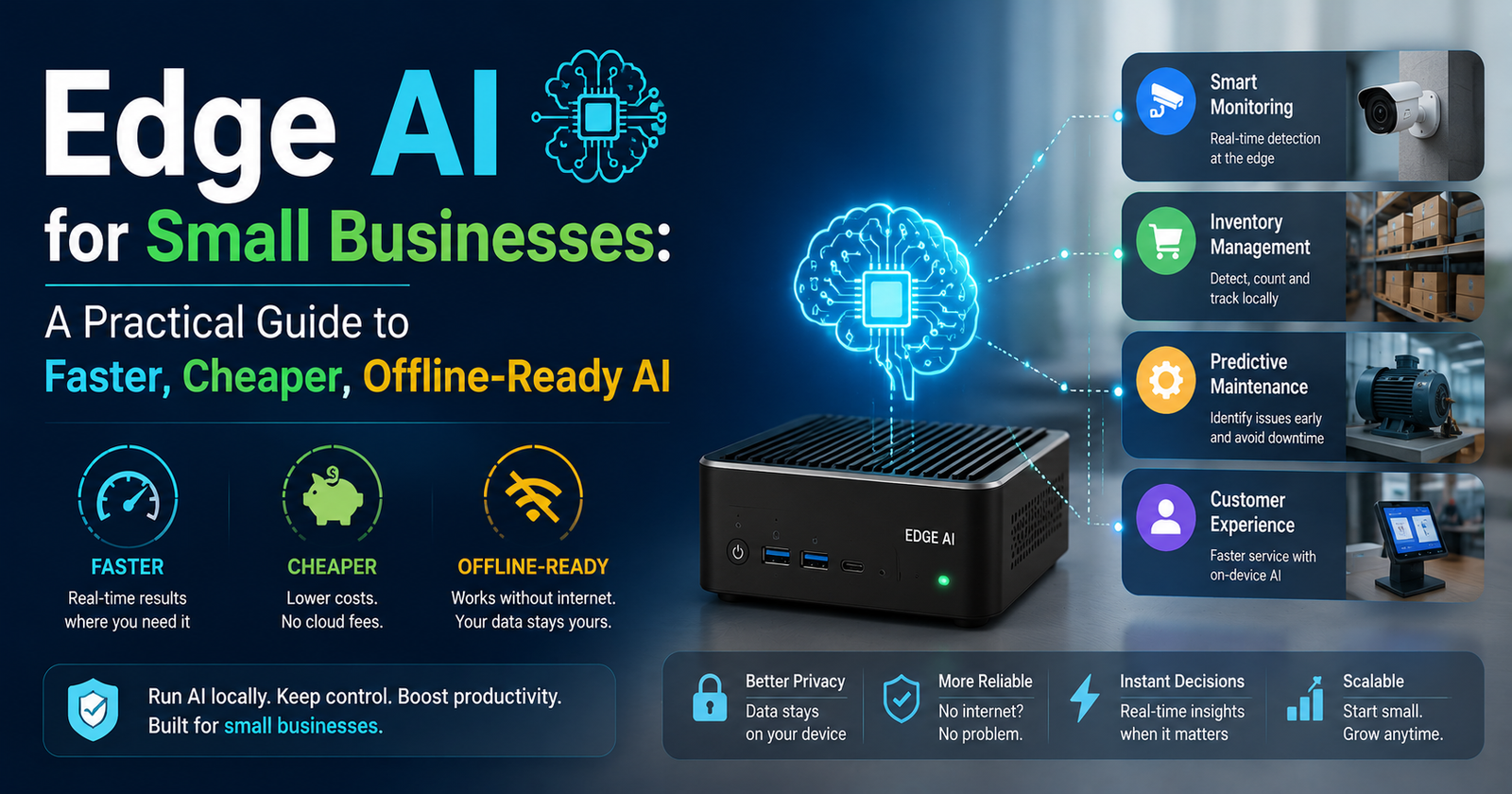

A guy who runs a small hardware store near where I used to live told me his internet drops out at least once a week. Not for long, twenty minutes maybe, but long enough that anything depending on a cloud connection just stops working right when he needs it. That’s the story most conversations about AI conveniently skip. Everyone talks about massive data centers thinking. Fine, true for a lot of applications. But for a small business — especially one that can’t guarantee rock-solid internet or doesn’t want a surprise cloud bill every month — that picture is basically irrelevant.
What “Edge” Even Means Here
Edge refers to the edge of the network. The point closest to where the data gets created in the first place, as opposed to some far-off cloud server. Edge AI means the actual thinking happens on a local device — a camera, a sensor, a point-of-sale machine, a small on-site box, even just a phone. No sending a photo or a sound clip across the internet, waiting, getting a result back. The device figures it out right there and gives you an answer immediately.
Compare that to the typical setup most people know, where you type something into a chatbot, it goes to a server somewhere, and comes back a few seconds later. That round trip takes time. It needs a stable connection the whole way.
Edge AI skips that round trip completely. Processing happens exactly where the data shows up.
Why This Actually Matters More for Small Businesses
Big companies can eat a huge cloud AI bill without blinking. They’ve got IT teams managing complicated infrastructure full time. Small businesses generally can’t do either of those things, and that’s precisely where edge AI stops being some nice-to-have and becomes the more sensible option.
A small shop running AI cameras for inventory doesn’t want a monthly bill that scales with how many video frames got analyzed. A small manufacturer watching for early machine failure through vibration sensors can’t afford for that safety system to just go dark the second the internet blinks out.
Predictable cost. Speed. Not depending on a connection that might not even be there.
How Small Hardware Even Runs This Stuff
Fair question — how does a tiny device with limited processing power run AI that’s normally associated with massive server farms? Comes down to model optimization, mostly. The huge general-purpose models behind most chatbots need serious computing muscle. Edge AI uses smaller models built to do one job really well — spot a specific object, recognize one particular sound, predict a narrow range of outcomes — instead of trying to be good at everything.
These smaller models go through something called quantization. Basically reduces the precision of the math the model’s doing, which shrinks the whole thing and speeds it up a lot, for a pretty small hit to accuracy.
The hardware side caught up too. Tiny AI accelerator chips, some no bigger than your thumbnail, are showing up built right into security cameras and point-of-sale systems and even cheap microcontrollers now. Real AI processing power without needing anything resembling a server room.
Where Small Businesses Are Actually Using This Already
Retail stores use edge cameras for shelf monitoring and theft deterrence and counting foot traffic, all processed locally so footage doesn’t need to leave the building unless something specific gets flagged. Restaurants monitor fridge temperatures with edge sensors, get an instant alert the moment something drifts out of safe range. Small manufacturers listen for weird vibration or sound patterns in their machinery, catching problems before they turn into an expensive breakdown down the line. Farms use cameras and soil sensors for crop health and irrigation, which matters a lot given how spotty rural internet coverage tends to be. Small clinics sort basic diagnostic images locally so sensitive patient data never has to travel anywhere.
None of this needs a data science team sitting in the back office. Most of it comes built into affordable hardware or software made specifically for people running small operations, not enterprises.
The Cost Side of Things
Cloud AI usually runs pay-as-you-go, cost scaling with usage. Works fine for occasional stuff. But for a business running AI constantly — say a camera watching a shop floor eight hours a day — those per-use charges add up fast, and now you’ve got one more unpredictable line item to budget around every month.
Edge AI flips that. Bigger upfront cost for hardware, sure, but after that the ongoing cost is minimal since there’s no constant cloud dependency.
There’s a bandwidth angle too that people forget about. A camera constantly streaming raw video to the cloud for analysis burns through bandwidth fast — matters a lot if you’re somewhere without cheap high-speed internet. An edge camera that only sends an alert when something actually happens uses barely any bandwidth at all in comparison.
Privacy, Which Matters More Than People Assume
Sending customer footage or transaction patterns or operational data to some third-party cloud always introduces risk, and always makes you dependent on however good — or not — that provider’s privacy practices happen to be. Edge AI cuts that down significantly because raw data often never leaves the building at all. A camera counting foot traffic can spit out a number without ever transmitting actual footage anywhere. A tool sorting patient scans can do it locally without those images touching an outside server, period.
Mistakes Worth Avoiding
Most common one — buying something marketed as “AI-powered” without checking whether the processing actually happens locally, or whether it’s still quietly routing everything through the cloud behind the scenes despite the marketing. Worth just asking directly, or checking the spec sheet, before assuming.
Another one, trying to solve ten problems with a single device. Edge models work best when narrow and focused. Something trying to detect ten different things at once usually performs worse across the board than a few smaller, purpose-built deployments each handling their own job well.
Where This Is Headed
Edge AI hardware keeps getting cheaper and more capable every year, and increasingly the software around it gets built for regular small business owners, not engineers. Stuff that used to require custom development is now something you can set up in an afternoon, more or less.
That matters for small businesses specifically because it levels a playing field that used to heavily favor whoever had the bigger IT budget.
Final Thoughts
Edge AI isn’t some scaled-down, lesser version of cloud AI. It genuinely fits a specific set of problems small businesses deal with constantly — unreliable internet, tight budgets, needing an instant answer instead of a delayed one from some server far away. Businesses that pick one clear, repetitive problem and match it to the right edge AI tool tend to see fast, measurable results, without needing to hire anyone technical or lock into an expensive ongoing cloud contract they’ll resent by month three.



[…] it from a passive thing you stare at into something that can actually summarize and draft and organize and, increasingly, just do stuff for you. AI browser productivity methods are the practical […]